


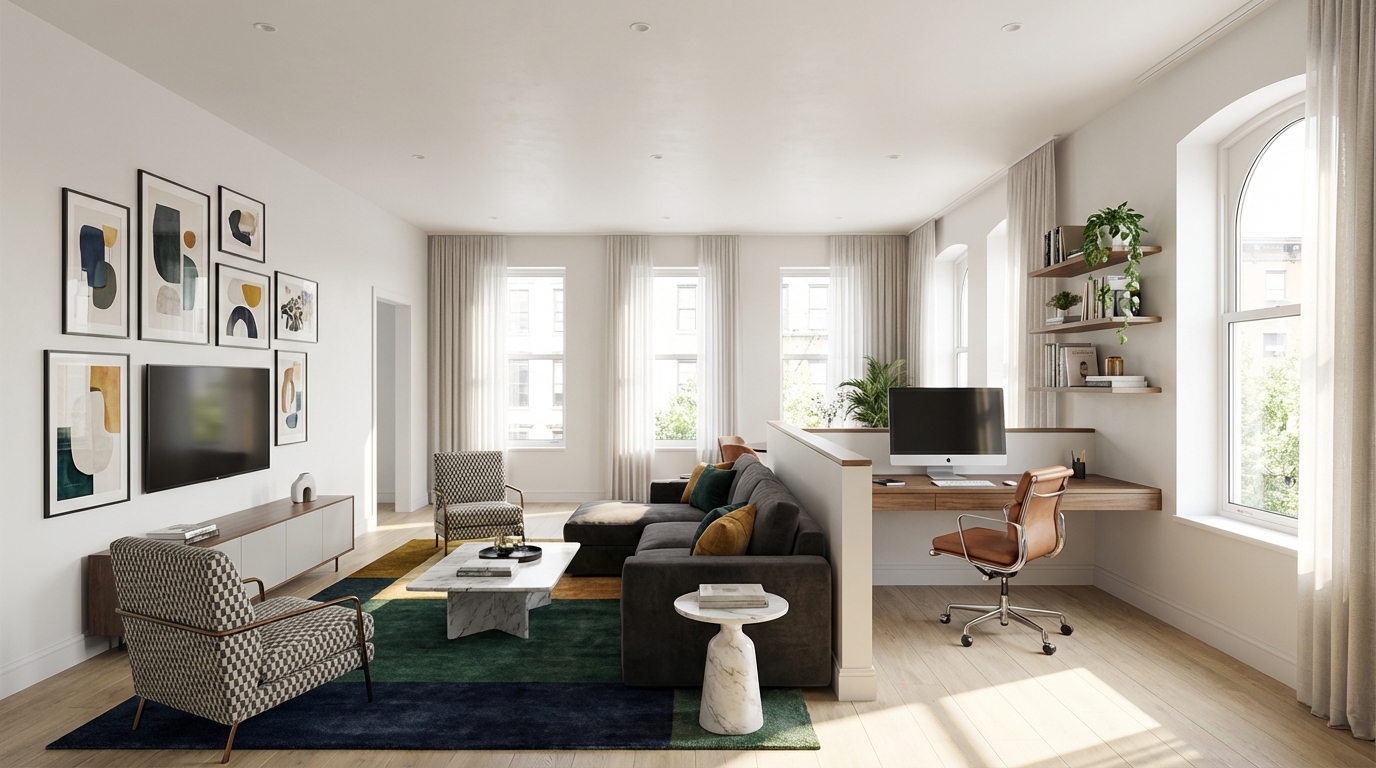
I feel like narrow living layouts can give off this real “bowling alley” feeling. Or sometimes it’s like you look up and suddenly realize you’ve been arranging furniture like you’re setting up a doctor’s waiting room. Awkward dimensions in a living space can be a little challenging, but they tend to create some of the most unique living spaces I’ve seen.
The big secret isn’t making the room look wider. It’s more about the length, finding ways to make it look intentional through thoughtful space planning. Break up that endless-runway-feeling with zones. Get your furniture away from the walls, please. Make people’s eyes wander instead of race from end to end with clever interior design strategies.
Quick Guide to Working With Long Spaces
- Dual zones work better than one big seating area – Think conversation pit plus reading nook, not mega-sectional wasteland
- Float your sofa away from the wall – Creates depth and breaks up that hallway vibe
- Stagger furniture placement – Forces a meandering path instead of a straight shot through
- Use one long wall for floor-to-ceiling storage – Turns a problem into an architectural feature
- An L-shaped sectional can actually truncate length – The short end cuts across the room’s width
1. How Can a Dual-Zone Layout Fix a "Bowling Alley" Living Room?
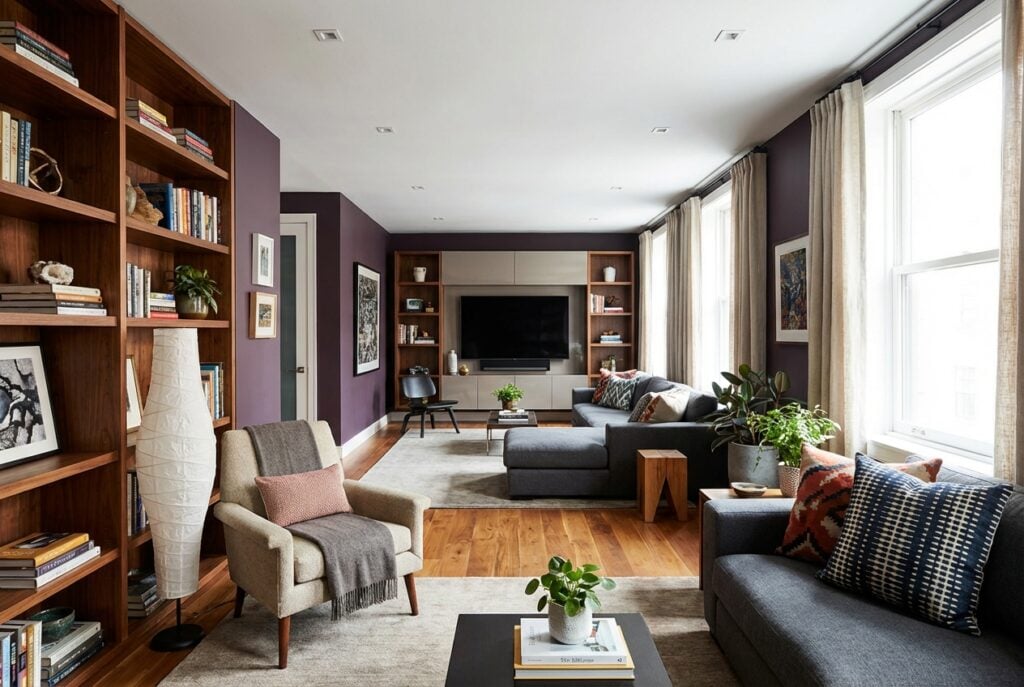
First, I want to start with this, and this isn’t a judgement, but please. Stop trying to make one giant conversation area. Just stop. In a long, narrow room, this creates a bland furniture lineup against the walls with a big empty middle that makes the seating feel like waiting in an airport terminal.
Instead, how about creating two separate “rooms” in your one long space, using some clever, strategic home styling. One half could be for entertainment, with TV area, and a reading corner with a bookshelf in the other half. Or a conversation area plus a small workspace. The Pottery Barn catalog does this constantly, although their rooms are usually enormous.
Area rugs are what make this actually work. A large 8×10 rug under your main sofa grouping, then a smaller 5×7 rug defining your secondary zone. Your brain will read these as two properly proportioned squares instead of one weirdly-long rectangle. West Elm’s jute rugs start around $200 and handle this job well without looking too matchy.
Leave breathing room between zones. Two or three feet of empty floor space acts like a hallway between your “rooms.” Pick furniture that has legs you can see under – think CB2 mid-century pieces with the skinny wooden legs, those are perfect because they keep the floor plane visible.
The lighting is what sells it. A floor lamp in the reading corner, maybe that IKEA Foto pendant that’s surprisingly decent for $25, plus a central fixture over the main seating. Two different lighting schemes make your eye think these are actually separate spaces with proper room aesthetics.
2. Why is "Floating" Your Furniture Essential For Maximizing Narrow Living Layouts?
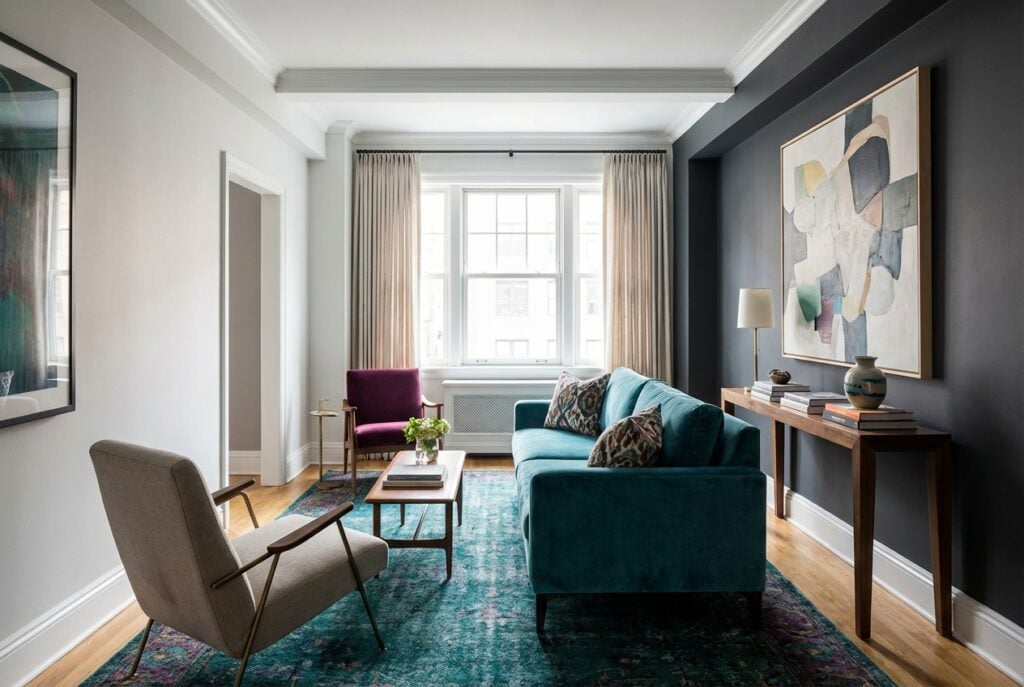
Everyone shoves furniture against walls in narrow rooms. Makes sense, right? Unfortunately, it really ends up making a room feel like a hallway with seating; transitional, basically.
Try pulling your sofa six inches away from the long wall. Just six inches creates shadow lines and depth that break up that flat wall plane. If you have enough width, float the sofa completely in the room with a narrow console table behind it. Target’s Project 62 line has console tables around 10 inches deep that work perfectly for this furniture arrangement.
The walkway behind a floating sofa feels intentional. People aren’t cutting through your conversation area to get across the room, they can easily weave around. Plus you can style the back of the sofa with a table lamp and some books, making it look like built-in furniture.
I think low-back sofas work best for floating. You don’t want to block sight lines across the room. That Room & Board Metro sofa everyone copies has the right proportions, though the IKEA Kivik does something similar for about a third the price.
Round coffee tables help too. Hard rectangular lines emphasize the boxy room shape. A round marble-look table from World Market, maybe $300, softens everything and creates better flow around the furniture for long narrow room design.
“Floating” furniture feels a little risky, but it actually makes narrow rooms feel wider. You’re creating a furniture “island” that draws people in instead of pushing them through.
3. How Does An Asymmetrical Arrangement Improve Traffic Flow?
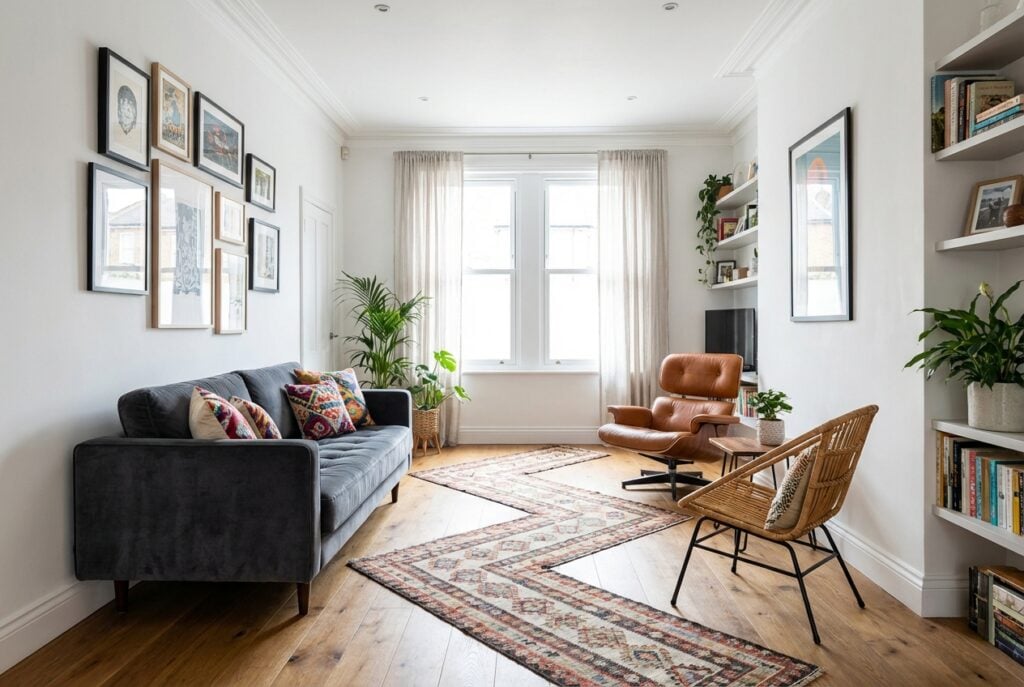
Symmetry in a narrow room creates a kind of runway. It makes your eye zip from one end to the other without stopping anywhere interesting. Asymmetry forces wandering, which weirdly makes the space feel bigger.
Place your sofa against (remember, leave a little space) one long wall, then put two different chairs across from it at slight angles. Not matching chairs. A leather club chair from Facebook Marketplace paired with a vintage wooden armchair, something like that. Use a cluster of small side tables instead of one big coffee table. CB2’s smart round tables nest together and you can pull them apart when needed.
You want to create more of an S-curve path through your room, not a straight line. People have to navigate slightly around furniture, which slows them down and makes the room feel like a destination rather than a transition space. This approach works beautifully for rectangular living room design challenges.
You can balance visual weight asymmetrically too. A tall plant in one corner, maybe that trendy fiddle leaf fig everyone’s obsessed with, then a hanging pendant light in the opposite corner. I’m not talking about matching elements, but more like similar visual weight distributed unevenly through smart decorative accents.
This mimics how people actually move and live. It feels super organic instead of staged lifeless. Plus you can use mirrors on the wall opposite your main seating to reflect the asymmetrical arrangement back, doubling the perceived width.
The slight chaos of mismatched placement can actually hide the rigid geometry of a narrow room. Your eye gets interested in the relationships between furniture pieces instead of measuring the distance from wall to wall.
4. Can A Statement Wall With Built-Ins Fix A Narrow Room's Proportions?
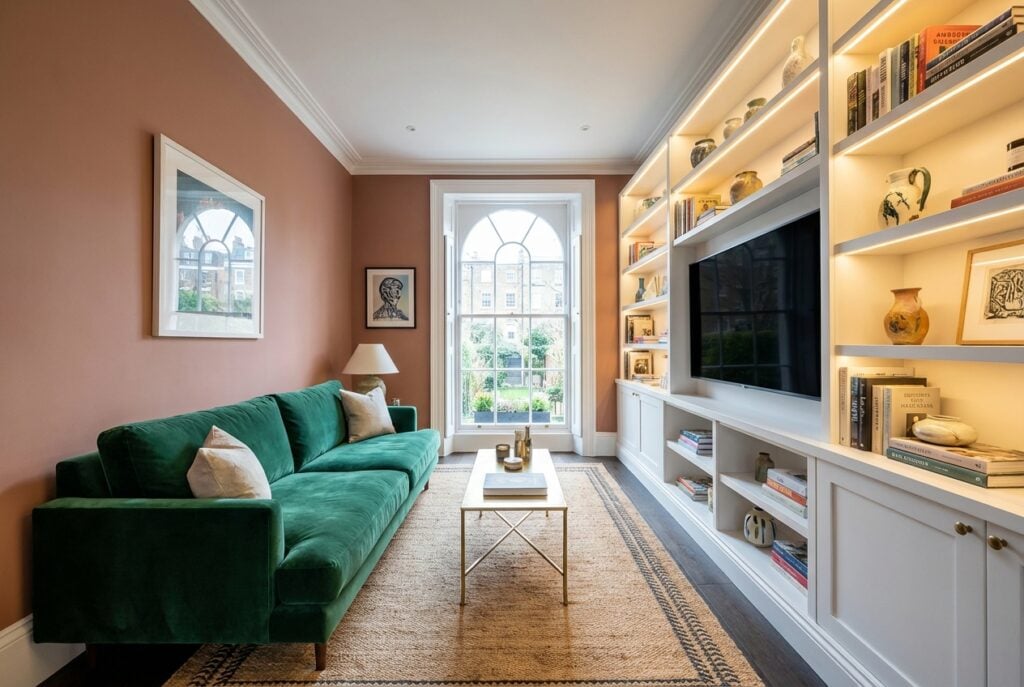
Long walls are the real problem in narrow rooms. They stretch endlessly and can make a living room feel like a train car. But turning one long wall into a floor-to-ceiling built-in situation can actually make the room feel wider.
I know it sounds a little backwards, but a deep, complex wall treatment gives your eye something interesting to explore along the length of the room. Instead of just measuring the distance from end to end, you’re looking at books, objects, maybe integrated lighting creating little pools of warmth.
IKEA’s Hemnes bookcases go floor-to-ceiling if you stack them, around $200 each. Paint them the same color as the wall and they recede visually while adding tons of storage. Or go dark with a moody navy or charcoal built-in wall can feel like it’s receding into the distance.
The other long wall should stay relatively simple. You can try one large piece of art or a few bigger prints. This creates a “busy wall, calm wall” balance that prevents the room from feeling cluttered while maintaining good visual balance in tight spaces.
If you have a fireplace, I recommend centering the whole built-in design around it. This creates a natural focal point that anchors the entire length of the room. The eye stops at the fireplace instead of racing to the far end.
Built-ins also make it so you don’t need random furniture pieces. TV stand, bookshelf, storage cabinet – it all gets absorbed into one architectural element. Keeps the floor clear, which is crucial in a narrow space.
5. Is An L-Shaped Sectional The Best Choice For A Long Room?

People think sectionals are only for huge, square family rooms. But the right L-shaped sectional can be perfect for narrow spaces. The short end of the L creates a visual “stop” that truncates the room’s length.
Make sure the short arm is across the width of the room. It’ll act like a soft room divider, without needing an actual wall. This is especially useful in open-concept spaces where your narrow living room flows into a kitchen or dining area.
The sectional back works as a natural boundary between spaces. You can style it with a console table, use it to hide cord management, whatever. It defines the lounge area but still keeps things open through some thoughtful small living room arrangement.
Look for apartment-sized sectionals with narrow arms. West Elm’s Andes sectional comes in apartment scale, around $1,200 for a small L-shape. The arms are only 6 inches wide instead of the usual bulky 10-inch arms that eat up precious space.
Make sure you have at least 30 inches between the end of the sectional and the opposite wall. Any less and people feel trapped. If the room is really narrow, get a sectional with a reversible chaise so you can experiment with which side the extension sits on.
Pair it with a round rug to soften all those L-shaped corners. The curve counteracts the angular furniture and makes the layout feel more spacious.
Using a sectional to “cut” the room transforms an endless rectangle into a cozy, defined nook. Makes the awkward length look completely intentional.
Frequently Asked Questions
How do I choose the right rug size for narrow living layouts?
Skip the long runner rugs. They just emphasize the room’s length. Instead, use rugs to create furniture zones. An 8×10 rug turned horizontally – with the long side going against the short wall – can actually push the walls out visually. In really long rooms, two separate rugs work better than one massive one. Make sure the front legs of all your seating furniture rest on the rug. Rugs USA has decent options around $200-400 that handle this job without breaking budgets.
Where should I place the TV in a long, thin room?
Mount it on one of the long walls with seating directly across. Sounds obvious but people overthink this. If the black screen bothers you when it’s off, Samsung’s Frame TV starts around $600 and displays art. Or create a gallery wall around a regular TV to integrate it better. In dual-zone layouts, put the TV in one half of the room so the other half stays screen-free for conversation.
Can I use dark colors in a narrow living room?
Dark colors can actually help narrow rooms. Paint the two short end walls a receding color like navy or charcoal – makes them feel further away and balances the proportions. Or paint the whole room dark for a cozy jewel box effect. Benjamin Moore’s Hale Navy is popular for good reason. Just make sure you have enough layered lighting. Dark rooms need table lamps, floor lamps, maybe some wall sconces to prevent cave vibes.
