

When you purchase through links on our site, we may earn an affiliate commission.

KEY TAKEAWAY – Matte black paint doesn’t shrink a room; it creates infinite depth.

The biggest myth in interior design is that dark paint makes a space feel like a tiny cave. Matte black absorbs light, causing the wall to visually recede and pushing the boundaries of the room further back. Follow some basic rules of contrast to bring the right type of drama to your rooms.

Black walls make a room feel smaller, right? Actually, it’s the opposite. Matte black absorbs light, which causes walls to visually recede. The room feels deeper, not tighter.

The trick is knowing where to stop. Paint every surface black and you’ll get a sensory deprivation chamber. But one accent wall, or just the lower half of a room? That’s when matte black does something no other color can: it creates depth while making everything else in the space pop.

Here’s how to use it without conjuring up the vibes of a goth teenager’s room.

Pick the Right Wall (Not All Walls)

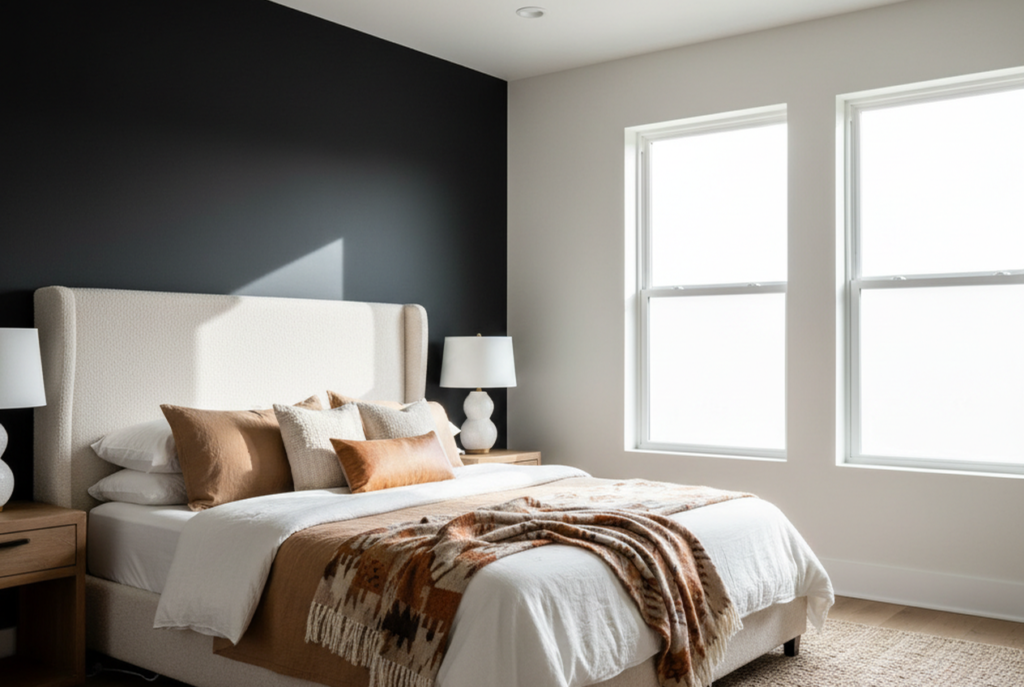
Bedroom with matte black accent wall behind bed and white trim detail
The wall perpendicular to your light source is usually the best candidate for matte black paint.

Start with one wall. The best candidate is usually the one perpendicular to your main light source – not the window wall itself, but the wall it faces. This lets natural light skim across the black surface instead of fighting it.

In a bedroom, the wall behind the headboard works because you’re rarely looking directly at it. You’re experiencing it as backdrop. Same logic applies to a dining room wall behind a table, or the short wall in a galley kitchen.

Avoid painting the wall with your room’s main focal point unless that focal point is white or metallic. Black needs contrast to work. If your fireplace is already dark stone, painting around it in black just creates a visual blob.

Test before committing. Grab a sample of Sherwin-Williams Tricorn Black (SW 6258) or Benjamin Moore Black (2132-10) and paint a 2×2 foot square. Live with it for three days through different lighting conditions. If it still feels right, go bigger.

  • Steal This Look: Get the cleanest finish with Benjamin Moore’s Black Satin paint, which hides imperfections better than cheaper mattes.

    Benjamin Moore – Black Satin

Balance It With White Trim (This Isn't Really Optional)

Clean paint line between matte black wall and white trim baseboard
White trim isn't decorative — it's what keeps a black wall from looking unfinished.

Matte black only works when it has a hard edge to define it. White trim, white ceiling, white baseboards. And these aren’t decorative choices. They’re structural necessities.

The contrast keeps black from bleeding into adjacent surfaces. Without it, the wall just looks dirty or unfinished, like you gave up halfway through painting.

Just make sure you use a true white, not cream or ivory. Benjamin Moore Simply White (OC-117) or Sherwin-Williams Pure White (SW 7005) both have enough cool undertones to stay crisp next to black. Warm whites look yellow by comparison.

If your trim is currently wood, you have two options: paint it white, or skip the black wall entirely. There’s no third path that works. Wood trim plus black walls reads as either rustic cabin (fine if that’s your vibe) or unintentional mismatch (probably not what you want).

  • Steal This Look: For crisp trim work without brush marks, use Purdy XL Series Angular Trim Brush, which holds more paint and gives you cleaner lines in fewer coats.

    Purdy XL Angular Trim Brush — Amazon

Light It Like You Mean It

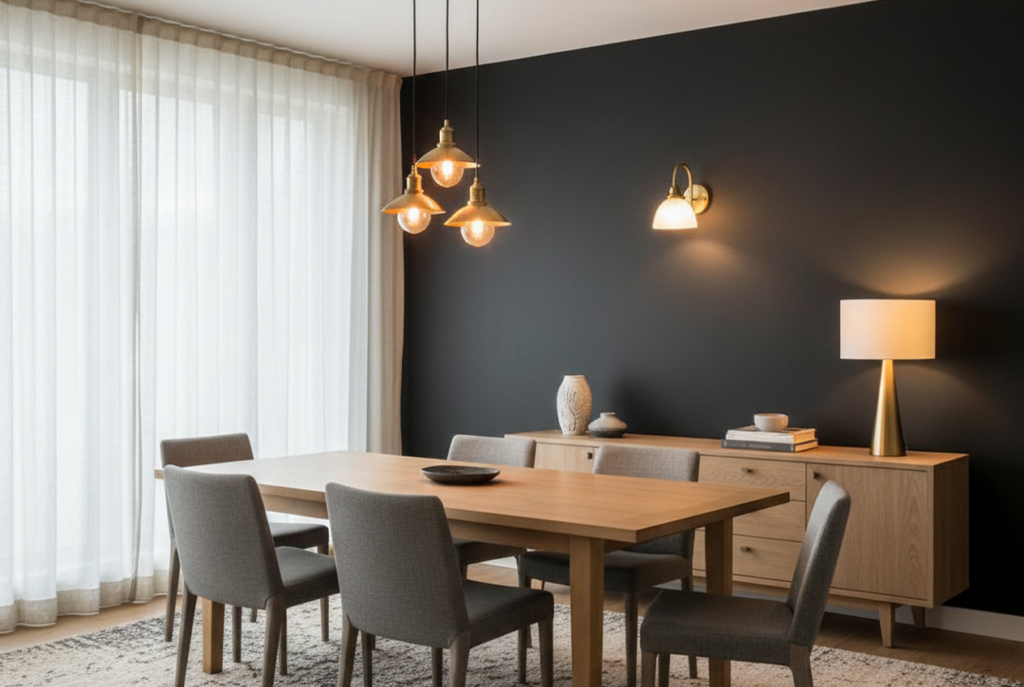
Black accent wall in dining room with layered lighting from multiple sources
Black walls need three times the light you think — layer ambient, task, and accent lighting at different heights.

A black wall needs three times the light you think it does. Ambient overhead lighting isn’t enough. You need layered light sources at different heights.

Start with a bright overhead fixture, at least 1500 lumens for a 10×12 room. Then add task lighting: a floor lamp next to the sofa, a table lamp on the console, picture lights if you’re hanging art. The goal is to create pools of light that the black wall can frame, not a dim cave you’re trying to brighten.

Warm white bulbs (2700K-3000K) work better than cool white against matte black. Cool white can make the space feel institutional. Warm white feels intentional and cozy.

Skip recessed lighting unless you’re adding five or more fixtures. One or two recessed cans in a black-walled room just create spotlight circles on the floor, leaving the walls in shadow. That’s when black stops feeling sophisticated and starts feeling like a mistake.

Style It With Texture, Not More Darkness

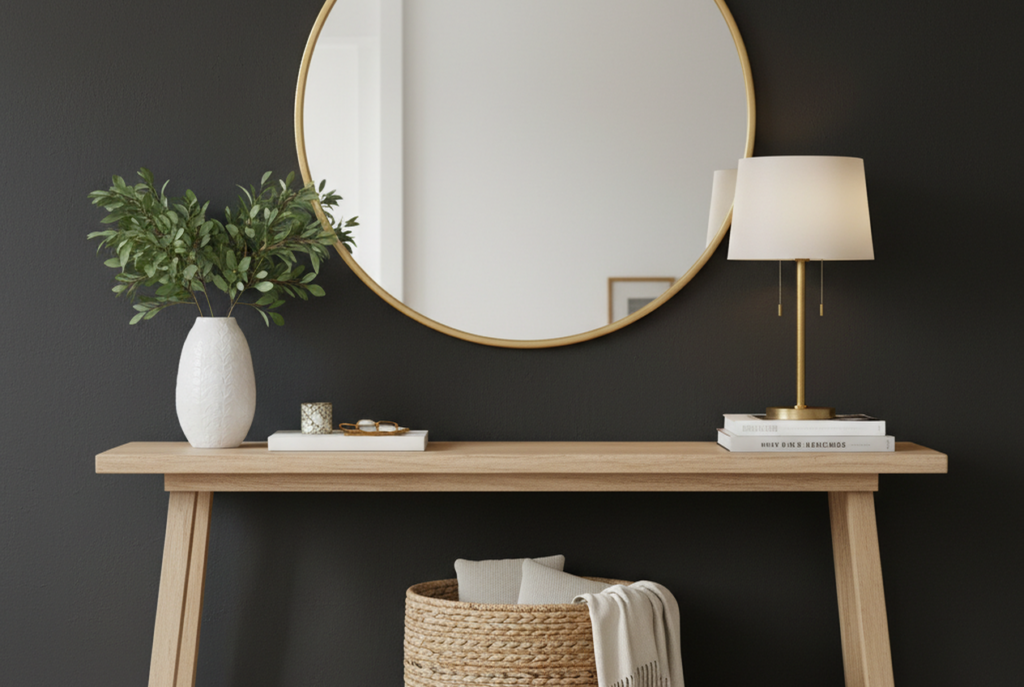
Console table against black wall with brass mirror and white ceramic accessories
Metallic finishes and white ceramics create the contrast matte black needs to work.

The biggest mistake people make after painting a wall black is decorating it with more black stuff. You start addding black frames, a black shelf, a black sconce. Now you’ve got a black hole instead of an accent wall.

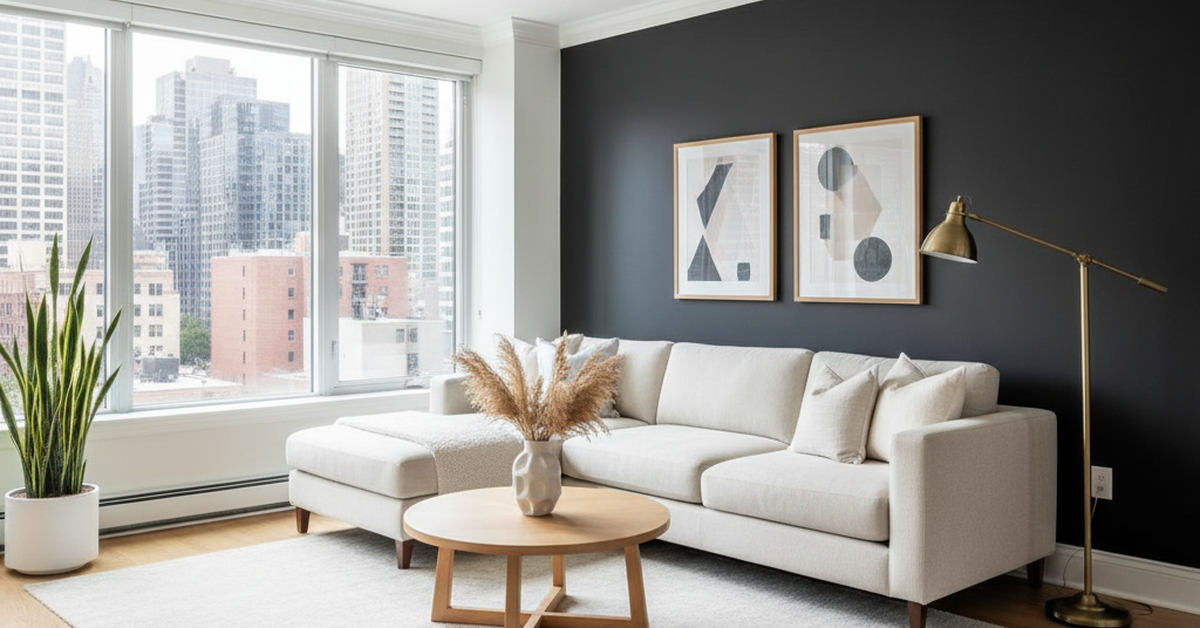
Add texture in contrasting materials: a chunky white ceramic vase, a jute rug, a brass mirror, linen curtains. These materials catch light differently than paint does, which keeps the eye moving instead of stopping dead at the wall.

Metallic finishes, like brass, gold, copper, look particularly good against matte black because the sheen contrast is so strong. A simple brass picture light or a gold-framed mirror becomes a focal point in a way it never would against white. The blackness of the wall should be warm and lush, not like staring into the void.

If you’re hanging art, use white or natural wood frames. The art itself can be any color, but the frame needs to create separation from the wall. Otherwise, even a colorful painting can disappear into the black.

  • Steal This Look: This round brass mirror from Promeed creates instant contrast against matte black and reflects light back into the room, solving two problems at once.

    Round Brass Mirror – Amazon

Keep the Ceiling White (Yes, Even If You're Tempted)

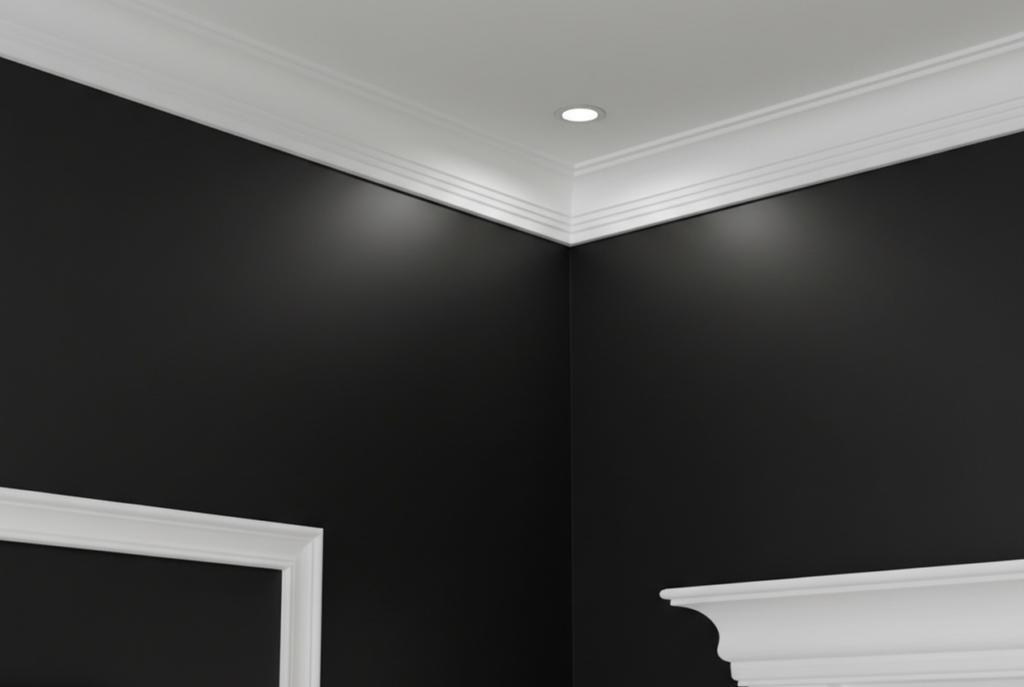
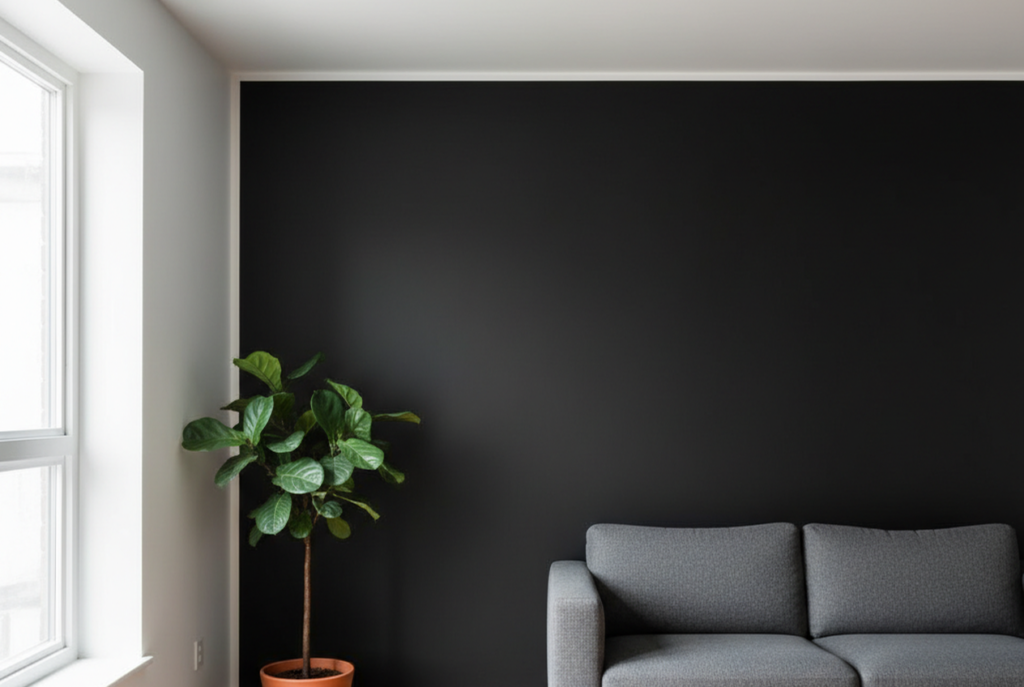
Matte black wall with white ceiling showing proper paint line separation
Keep your ceiling white to preserve the sense of height, even in rooms with black walls.

You’ll see photos of rooms with black ceilings that look amazing. Those rooms are 14 feet tall with floor-to-ceiling windows. Yours probably isn’t.

A black ceiling in a standard 8-9 foot room creates a lid effect. The space feels compressed, and not in a cozy way. In a literally-can’t-breathe way.

Keep the ceiling white. If you want more drama, paint the black down to about 6 inches from the ceiling, then run a clean white line. This preserves the height illusion while still giving you the moody wall you want. Check this detailed exploration of light/dark in relation to floors and walls.

The same logic applies to floors. Dark floors plus dark walls need a lot of space and light to work. If you’re in a small room or one without great natural light, keep the floor light or go with a light-colored rug that covers most of it.

  • Steal This Look: A cream or ivory area rug made by Srugn on Amazon, grounds the space and prevents the black wall from feeling too heavy, especially in smaller rooms.

    Ivory Wool Area Rug — Amazon

Prep the Wall (Or You'll See Every Flaw)

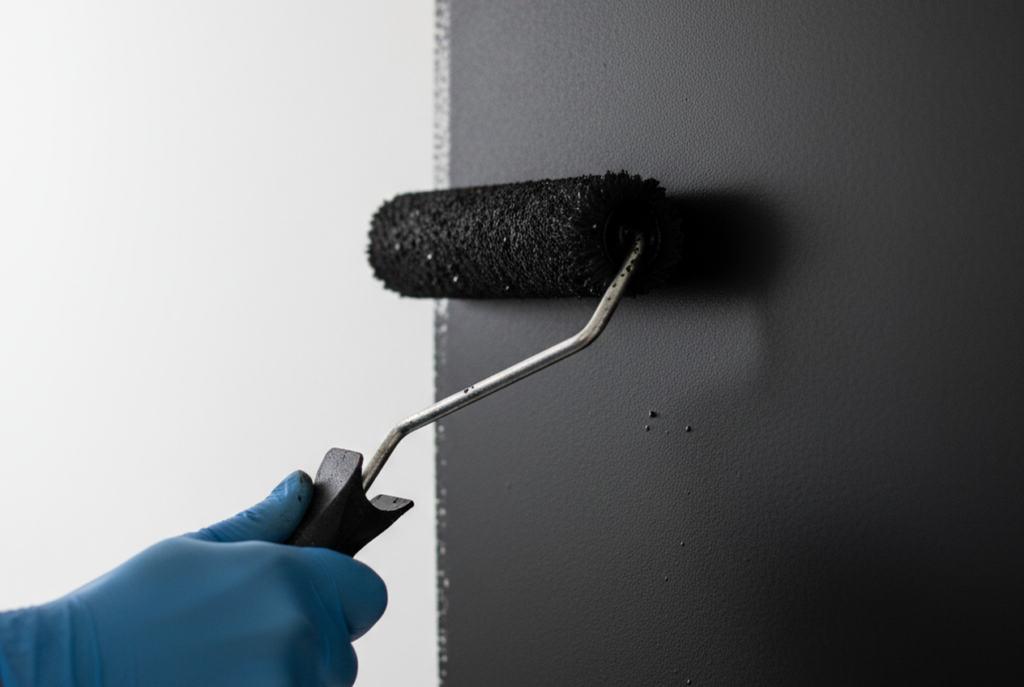
Paint roller applying matte black paint to properly prepped and primed wall
Gray primer and quality rollers are non-negotiable for achieving a smooth matte black finish.

Matte black can be…unforgiving. Every dent, crack, and texture inconsistency will show. Not in direct light, that’s when glossy paint shows flaws. Matte black shows them in shadow, which is somehow worse.

Fill nail holes with spackling compound, sand smooth, then prime with a gray-tinted primer. White primer under black requires more coats. Gray primer (like Zinsser Bulls Eye 1-2-3 in gray) gives you better coverage in two coats instead of four.

If your walls have texture, decide now whether you can live with it. Orange peel texture amplifies under matte black. If it bothers you, skim coat the wall before painting. If you can live with it, embrace it as part of the room’s character.

Use a high-quality roller cover, 3/8 inch nap for smooth walls, 1/2 inch for slight texture. Cheap rollers leave lint in the finish, and lint shows up as white specks against black. You’ll spend more time picking them out than you saved buying the cheap roller.

Frequently Asked Questions

Q: Does matte black paint need more coats than other colors?

A: Two coats over gray primer is usually enough with quality paint like Sherwin-Williams Emerald or Benjamin Moore Advance. Cheap paint will need three or four coats, which ends up costing more in time and materials. The upfront cost of premium paint pays off in coverage and how the finish looks a year later.

Q: Will matte black paint show every fingerprint and smudge?

A: Surprisingly, no. Matte finishes hide smudges better than eggshell or satin. The lack of sheen means there’s no reflection to catch the oils from fingerprints. High-traffic areas like hallways or kids’ rooms are actually better candidates for matte black than satin white, which shows every mark.

Q: Can I use matte black in a rental without losing my deposit?

A: Check your lease first, but most landlords care more about quality than color. If you do a professional-looking paint job with proper prep and clean lines, black is no different than any other color you’d need to paint over when moving out. Keep a record of the original wall color (take a paint chip to the hardware store for matching) so you can restore it later. Or ask upfront — some landlords will let you leave it if it’s well-done.

Share.

Room Decorating Ideas (RDI) is your trusted source for home décor inspiration, interior design tips, and practical room makeover ideas that elevate any space. For more than a decade, we’ve helped readers discover fresh decorating inspiration—from trending design styles to budget-friendly DIY projects. As your creative home décor partner, RDI blends beautiful aesthetics with functional, real-life solutions. Our mission is simple: to help you design rooms that reflect your personality, fit your lifestyle, and make you feel at home.